

Jian Zhi
by
Wang S.
The art of Chinese paper cutting (jian zhi) is considered one of the oldest forms of folk art in China. Created in Baoji about 2,000 years ago, the art has gradually become a mixture of Chinese people’s spirit and Chinese culture. Jian zhi is generally created for festivals (especially for the Spring Festival) and is placed on walls, windows, and even lanterns to bring joy and luck.
Jian zhi features a diverse range of exaggerated figures and objects. For example, a fish may be bigger than a boat to make the fish, not the boat, the focus on the piece. A traditional way to make jian zhi is to fold the paper and then draw lines on one side, which are to be used for cutting with a pair of scissors. This means that jian zhi pieces are always symmetrical. However, the artist sometimes places some Chinese characters on their work. Because these characters are not symmetrical, the paper needs to be opened, and a knife is used to carve the required character. In this way, the art consists of different techniques and requires the creator’s ability to both cut and carve. Even a small mistake could ruin the whole work.
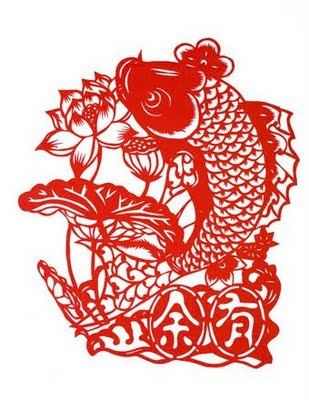
(Image source: http://img4.imgtn.bdimg.com/it/u=2725856005,1714543105&fm=21&gp=0.jpg)
In terms of tools, the scissors are most commonly used, but there are many other tools, including pencils, knives, brushes, and synthetic dyes. Jian zhi pieces sometimes need to be colored because of their themes. Here an electric iron may be used to press wet (dyed) paper. In this regard, jian zhi is not as easy as some people think. It requires many techniques and skills that require years of training and practice.
Chinese paper cutting is an important part of Chinese culture, particularly because its themes always derive from Chinese folk stories and show people’s sentiments. Jian zhi is clearly a form of Chinese art worthy of being preserved and promoted.
 Posted in